

Can you develop good taste?
every stylish woman has a graveyard of bad decisions behind her...

There is a quiet, slightly snobbish conversation that happens in fashion circles, and in art circles, and in music circles, and probably also somewhere very expensive in interior design, which goes, more or less: you either have it, or you don’t. Taste, the implication runs, is the rare gene. Some lucky daughters were born with it humming under their skin in the cradle, and the rest of us, sweetly, are going to have to make do with whatever the high street is selling this month.
Reader, I would like, gently, to call this what it is. A lie.
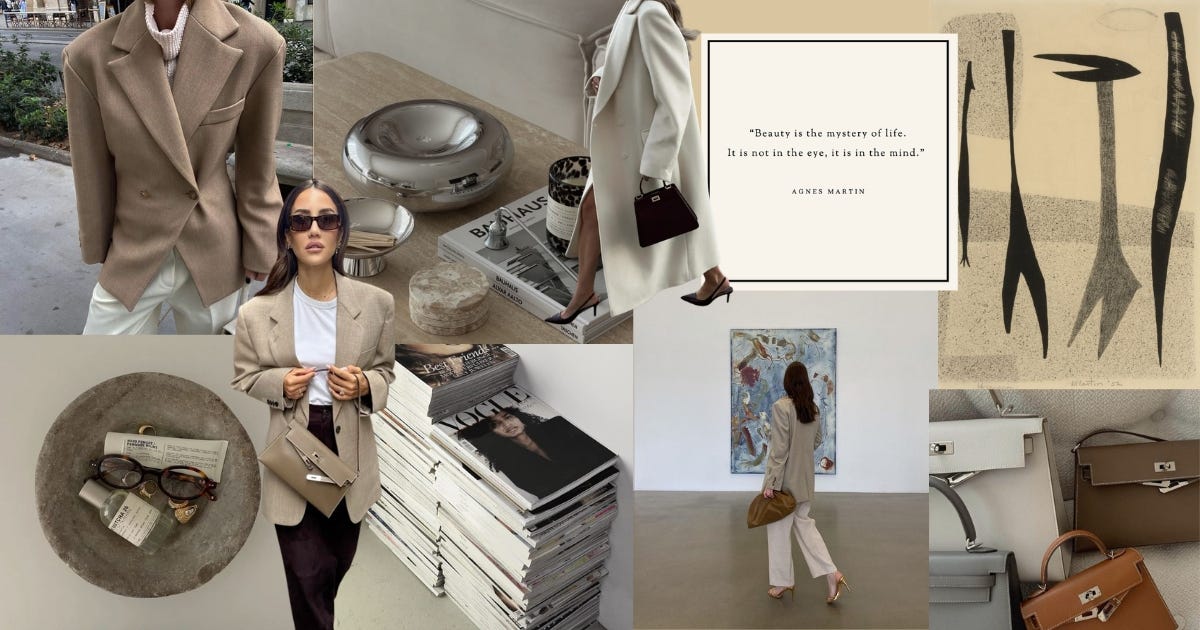
It is a lie told by people who would quite like the gates to remain closed. It is a lie told by some of those people to themselves, because the alternative, that their taste is the result of years of looking, comparing, failing, and cringing back at old photographs of themselves, is rather less flattering than the gene story. And it is a lie that does real damage to the rest of us, because we have all, on occasion, walked out of the house in something we now know was a mistake, and concluded, quietly, that taste was simply not in our nature.
Permit me a small confession to anchor this. I once, in a fit of inexplicable confidence, bought a pair of trousers I genuinely believed were the trousers of a woman who knew exactly what she was doing. They were not. I wore them once. I still, occasionally, think about them. The point of telling you this is not that I have suffered (although I have; thanks for asking) but that the trousers were, in their own peculiar way, an education. I now know precisely what I do not look good in. I would not, six months earlier, have known. Taste is, wait who determines what good taste is?
Taste, I would argue, is one of the most acquired things a person possesses. It is not in the cradle. It is in the looking and in the small, absorbed mortifications that come from having looked wrongly. Its sort of like a digital code mixes go what your grandmother used to read to you, which plays you went to, what kind of music was listened to in your house. Who are your friends, what they like. There are so many things that determine the taste.


Consider the most boring example, which is also the most clarifying. Children do not like olives. They do not like coffee, or wine, or the rind on the cheese, or anchovies in any context. We do not stand over a four-year-old and lament her lack of palate. We say, give it time. We understand her tongue is, biologically and culturally, on a journey. By thirty-five, she will be the woman ordering a dirty martini and a side of marinated Cerignolas with the absolute certainty of a sommelier. Nobody calls this hypocrisy. Everybody calls it growing up.
The same, almost, is true of fashion, and of art, and of the long, slightly humbling business of learning to enjoy music you used to find boring. (I would, here, like to sincerely thank the friend who once made me listen to that album when I really did not want to. You were right. I am sorry.) I would like to thank Roberto Bolle for his incredible Bolero performance which made me listen to it on repeat on a flight to Tokyo. Not biologically, of course; nobody was born unable to perceive a beautiful coat. But culturally, absolutely. You walk past a thousand ill-fitting blazers before you understand, on a perfectly ordinary Tuesday afternoon, what a well-cut shoulder actually looks like. You wear the wrong shoe with the right dress about forty times before the rule arrives, fully formed, in your kitchen one morning. You buy the trend. You wear the trend. You eventually, with the small private shame of any honest person, take the trend to the charity shop. That is taste being made. It is not a gift. It is a bruise. Some learn it sooner, some never.
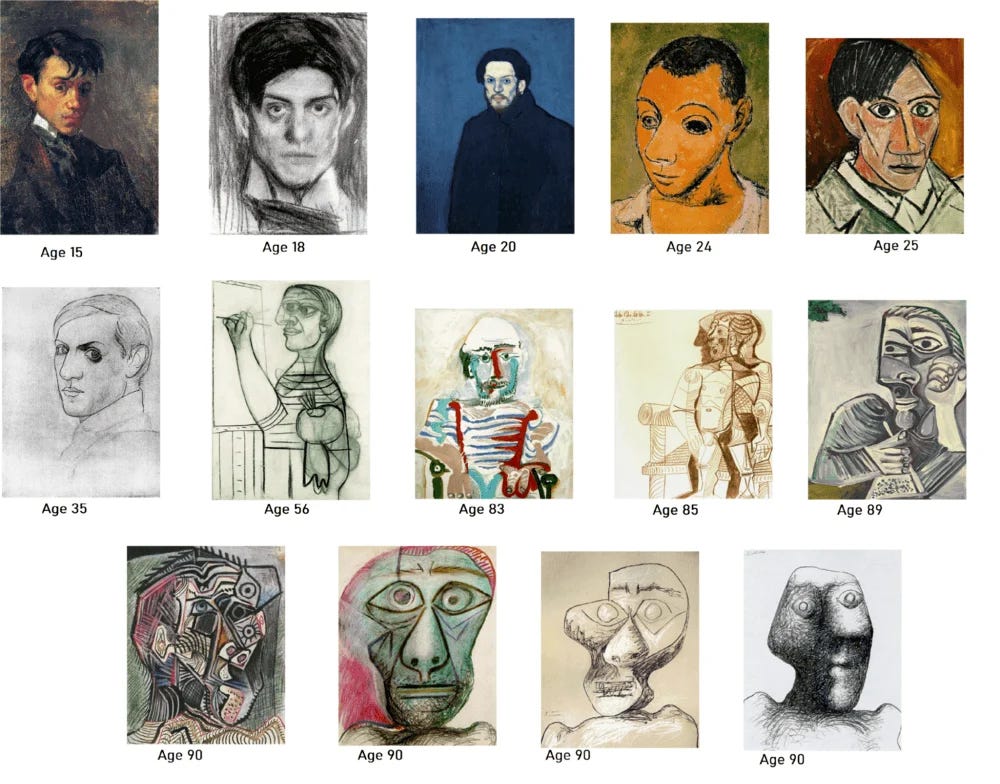
The same architecture, I think, holds for art. Nobody walks into a gallery aged fourteen and gets Agnes Martin. You stand in front of a hundred paintings you find boring or confusing or vaguely embarrassing, and one afternoon, usually somewhere unglamorous, somewhere you were not even particularly paying attention, a painting cracks something open in you. You go home and read about her. You see her again. You begin to recognise, in other rooms, the things she taught you to look for. The eye is built. It is not delivered.
I would go further, slightly recklessly. The women whose taste I find most extraordinary are, almost without exception, the women who have looked the most. They have spent time in archives, in vintage stores, in their grandmother’s wardrobe, in films their friends found dull. They have read about clothes the way other people read about politics, seriously, with footnotes. They have made wrong calls in public and not collapsed about it. The myth of the woman who simply knows, who arrived fully formed, is one of the most exhausting fictions we tell ourselves, and it gets passed off as a compliment when it is really a refusal a way of pretending the work isn’t there, so that anyone who hasn’t done it can be politely excluded. I would go even one extra step further to say that bad taste is better than no taste. I know so many beige women with beige taste that is very much average, and again would prefer observing women with what is snobbishly called bad taste, they are so much more interesting and brave.


A note, because the topic will dissolve the moment we turn our backs on it. Saying taste can be developed is not the same as saying all taste is equally good. I do not believe that. There is such a thing as a more interesting eye and a less interesting one. There is such a thing as a sense of proportion that has been worked on, and one that has not. Taste is not democratic in the sense that every choice is equally fine. It is democratic in the sense that the door is always, always open - and the only entry requirement is that you are willing to keep showing up, to keep looking, and to occasionally admit that what you wore last summer was not, in fact, your finest hour.


So yes. Taste can be developed. It probably has to be. Almost everybody whose style or eye you admire is, I would bet, on their fifth or sixth draft. Mine certainly is. The good news is that this means none of us are excluded. The slightly more inconvenient news is that nobody gets to coast.
You learn taste the way you learn anything that really matters. Slowly. Embarrassingly. In public, by looking through a history glass.
By paying attention.
Xx, T
Love this!
I love the idea that everything, including taste is a work in progress (please never stop writing, you re really good at this!!!)